Archive for category Platelet Rich Plasma
New Technologies Leading to New Concepts
Posted by Mitchell B. Sheinkop, M.D. in Platelet Rich Plasma, Stem Cells on September 13, 2011

Musculoskeletal Care of the Mature Patient
Probably the most important change in Osteoarthritis I have witnessed during my orthopedic career has been in attitudes rather than knowledge. The Boomers look toward continued well-being and extended athleticism and are unwilling to accept impairment and limited function associated with their osteoarthritis. Perception is everything; and new technologies lead to new concepts. Osteoarthritis is common and not necessarily a progressive disorder, with the condition stabilizing in most cases. This is obvious if we compare the number of people in the population with radiographic evidence of OA and the number who come to joint replacement. Recent research has indicated that physical activity optimizes cartilage health and is important in preventing the symptoms even in the presence of radiologic evidence of osteoarthritis. What about these new technologies and their increasing popularity owing to celebrity athletes?
What caused me to focus the blog again on Platelet Rich Plasma and Stem Cell management of osteoarthritis is an article appearing in the September 4, 2011 issue of the New York Times: As Sports Medicine Surges, Hope and Hype Outpace Proven Treatments by Gina Kolata. It is a well-written article and worth a Google. The introduction to the article describes the costly failure of physical therapy, strength training, Platelet Rich Plasma and cortisone injections in the care and treatment of a female marathoner’s hamstring tear. “ Medical experts say her tale of multiple futile treatments is all too familiar and points to growing problems in sports medicine” “Celebrity athletes, desperate to get back to playing after an injury, have been trying unproven treatments, giving the procedures a sort of star appeal.” You know what, I believe the author is right but does that make it wrong? I believe we must start with patients before we focus on populations. Researchers are indeed questioning the new procedures such as PRP and stem cells because there are no rigorous scientific studies to back them up. Yet there is a large group of patients eager for treatment, ranging from competitive athletes to casual exercisers to retirees spending their time on the golf course or tennis court who want to keep going.
So how do you protect yourself from the triad of famous athlete, famous doctor, untested treatment when there is so much marketing by sports medicine “experts”? First of all, make sure your sports medicine physician is a member of the American Academy of Orthopedic Surgeons because these experts are trained in offering care based on credible evidence. The continuing education initiative of the AAOS is the most advanced of any medical specialty. Second, when a procedure is new and unsupported as of yet by a large clinical experience/ data base, seek out a clinical trial and not simply a clinical encounter. In 1979, I was involved in the clinical trial of a cement-less design hip prosthesis which ultimately changed the surgical approach to joint reconstruction in the world. Management of osteoarthritis is complex and needs individualizing; so too, new isn’t always better but sometimes it just may be.
Meanwhile back to that “hamstring tear”. Any supposed chronic hamstring tear is more likely referred pain from a degenerated or herniated lumbar disc but referred pain and missed diagnoses are for another blog
Mitchell B. Sheinkop, M.D.
847-390—7666
1565 N. LaSalle Street
Chicago, Illinois 60610
Emerging ideas
Posted by Mitchell B. Sheinkop, M.D. in Platelet Rich Plasma, Stem Cells on August 22, 2011

For the skeptic and naysayer, Stem Cell Therapy is coming of age. What further validation is needed than the recently announced symposium?
First Annual Symposium on Regenerative Rehabilitation
November 3 – 4, 2011
Sponsored by:
University of Pittsburgh School of Medicine Center for Continuing Education in the Health Sciences
UPMC Rehabilitation Institute
The McGowan Institute for Regenerative Medicine
University of Pittsburgh School of Health and Rehabilitation Sciences
University of Pittsburgh Department of Physical Medicine & Rehabilitation
Intent
Medical advances in the field of Regenerative Medicine are accelerating at an unprecedented rate. Re-growing a lost limb, restoring function to a diseased organ, or harnessing the body’s natural ability to heal itself are becoming part of our reality instead of a distant promise. Technologies, such as cellular therapies, bio-scaffolds, and artificial devices, are now in use or are being tested in clinical trials throughout the country.
••How do we as clinicians and rehabilitation professionals follow up on a patient who had undergone a cellular therapy or a tissue engineering procedure?
••How do we as investigators in the field of Regenerative Medicine make the most of these revolutionary results?
Few opportunities are available to bring together scientists and clinicians working in these two currently quite disparate fields: rehabilitation science and regenerative medicine. However rehabilitation science and regenerative therapies have to work closely in order to achieve a successful outcome for the patient. This situation created the need for open cross-disciplinary work and collaborative communication.
This symposium provides the opportunity for researchers and clinicians from around the world to gather and learn about the latest developments, share ideas and concepts and create sustainable collaborations. The First Annual Scientific Symposium on Regenerative Rehabilitation will bring together world-renowned experts in the fields of regenerative medicine and rehabilitation.
Meanwhile, back in Chicago, we are ready to move forward with our Musculoskeletal Rejuvenation program using Bone Aspirate Stem Cells. We have two protocols, one in the knee and one for the plantar fascia.
Our research team is Mitchell Sheinkop, MD, (Orthopedic Surgeon, Emeritus Professor, Rush University Medical School) Lowell Scott Weil, Sr., DPM; Director Weil Foot-Ankle & Orthopedic Institute, Lowell Weil, Jr, DPM, MBA (Fellowship Director, Weil Foot & Ankle Institute; Co-Editor, Foot & Ankle Specialist.
We will have further communications and a prompt launch of our initiative. Our group in Cabo, Mexico, eagerly awaits our report as well concerning the launching of the Weil Foot, Ankle and Orthopedic Institute “Destination Rejuvenation Program”.
Emerging ideas
Posted by Mitchell B. Sheinkop, M.D. in Platelet Rich Plasma, Stem Cells on August 9, 2011

Musculoskeletal Care of the Mature Patient
On January 9, 2009 I wrote my first Blog. The emphasis at the start up was joint replacement of the hip and the knee for arthritis. All are archived at www.sheinkopmd.com. In mid-March, 2010, my emphasis shifted to Musculoskeletal Care of the Mature Athlete or how to avoid joint replacement, somewhat influenced by personal motivation. Today is my 100th blog and I will focus on the future of orthopedics: Bone and Joint Rejuvenation.
Treatment of Pre-collapse Osteonecrosis Using Stem Cells and Growth factors. Avascular Necrosis or (ON) of the femoral head is a devastating disease, a form of arthritis, affecting young patients at their most productive age, causing major socioeconomic burdens. ON is associated with various etiologic factors, and the pathogenesis of the disease is unknown. Most investigators believe the disease is the result of secondary microvascular compromise with subsequent bone and marrow cell death and defective bone repair. Could local delivery of vascular endothelial growth factor (VEGF) and bone morphogenetic protein-6 (BMP-6), which induces angiogenesis and osteogenesis respectively, reverse the disease process and provide a treatment for precollapse ON?
Use of genetically engineered bone marrow stem cells, carrying VEGF and BMP-6 genes, to enhance angiogenesis and osteogenesis in the necrotic bone by local delivery of growth factor in addition to the bone-forming property of the stem cells, tissue repair of the femoral head may be possible.
Imagine an injectable bone graft substitute containing engineered stem cells and therapeutic growth factors rather than hip replacement for a young person in need of treatment for ON.
Non Surgical Orthopedic Therapy: A Growing Trend and increasingly viable option. Pittsburgh Steelers ‘s Hines Ward and Troy Palomalu underwent Platelet Rich Plasma injections in 2009. Tiger Woods went to Canada in 2010 for PRP to the knee. Superbowl Champion Jarvis Green underwent stem cell therapy in 2010 and subsequently signed with the Houston Texans when it was thought his career was finished. Yankees” Roberto Colon underwent stem cell management of his shoulder in 2011.When it looked as if this 35-year-old pitcher had reached the end of his career; he now is in the Yankee starting rotation. Kobe Bryant traveled to Germany for non-surgical management of his arthritic knee earlier this summer.
Elimination of surgical risks, the extensive rehabilitation following joint replacement and the inherent restrictions of a total hip or total knee is my motivation with this 100th Blog. To do everything I can to make the future available in a clinical setting in the here and now. Last night, we came very much closer to making stem cell care of bone and joint pain a reality.
Making the case for stem cells and PRP
Posted by Mitchell B. Sheinkop, M.D. in Platelet Rich Plasma, Stem Cells on August 1, 2011

Musculoskeletal Care of the Mature Patient
Stem Cells May Prevent Need for Joint Replacements, if FDA Allows It June 1, 2011 PRNewswire-USNewswire
“Preliminary studies show that many patients with osteoarthritis might be able to avoid total knee replacement with this therapy.”
The orthopedic surgeon has historically depended on comparative effectiveness research to provide the science for supporting results. Yet the explosive growth in the number of costly orthopedic procedures-including joint replacements, back surgeries, arthroscopic procedures and other treatments-has attracted the attention of legislators, payers, employers, and experts in both health care and economics. In many of these cases, there is no scientific evidence to support the effectiveness of these procedures. I am trying to understand how Platelet Rich Plasma affects the healing process and whether there is an appropriate type of PRP for a specific orthopedic condition. Minimally Invasive Needle Injection of stem cells and PRP have very little draw back and are certainly less costly treatment options than major surgical procedures with their inherent complications.
Platelets provide an autologous source of growth factors for healing and tissue regeneration. Studies involving the use of PRP for cartilage degeneration have shown consistently favorable results. PRP injections in the knee have resulted in less pain, improving function and enhancing quality of life. A comparison of Platelet Rich Plasma with hyaluronan injections (visco-supplementation) for osteoarthritis of the knee found improved scores with PRP.
Mesenchymal stem cells (MSCs) secrete large quantities of various cytokines and growth factors thereby modulating the local immune response. They can be harvested in large quantities, expanded and used to regenerate bone and cartilage.
The emerging field of regenerative medicine aims to provide the required elements to promote tissue regeneration; total joint resurfacing to manage conditions such as osteoarthritis. Development is being stalled by the Federal Food and Drug Administration regulation of cellular therapy. The potential for rebuilding tissue is similar to our embryonic development. What we know is that cartilage rebuilt from MSC influence is very functional; what is unknown is long-term remodeling behavior, which may compromise the biologic resurfacing. Before making any clinical decision regarding any and all forms of treatment be it surgery, Platelet Rich Plasma or Stem Cells, discuss your candidacy with an orthopedic surgeon as all medical procedures have a success and failure rates.
In continuing to assure my reader fairness and balance in the field of reconstructive surgery, I want to call your attention to the OA of the Knee Registry paper of which I am co-author that will be published as a supplement in the October, 2011 edition of Rheumatology News.
Platelet Rich Plasma (PRP): Kobe Bryant tries new therapy
Posted by Mitchell B. Sheinkop, M.D. in knee, Platelet Rich Plasma on July 5, 2011

From ESPN Los Angeles.com July 1, 2011Platelet
Los Angeles Lakers guard Kobe Bryant underwent an experimental but increasingly popular procedure last month in Germany in an attempt to help heal his oft-injured right knee, a source confirmed to ESPNLosAngeles.com Thursday night.
The procedure, called platelet-rich plasma therapy, consists of centrifuging the patient’s blood to isolate platelets and growth factors. The mix is then injected into the injured area to accelerate healing. The concentrated growth factors have been shown to speed tissue growth and healing in surgically created lesions in lab animals.
Golfer Tiger Woods, New York Giants defensive tackle Chris Canty and Philadelphia Phillies pitcher Cliff Lee also reportedly have undergone the treatment.
However, a number of recent studies dispute the effectiveness of the treatment. The New York Times cited a study by Dr. Leon Creaney in the British Journal of Sports Medicine in which patients treated with injections of whole blood for tennis elbow had better outcomes than those treated with PRP therapy after six months.
Another study conducted by doctors in the Netherlands that was printed in the British Journal of Sports Medicine and cited by the Times examined patients treated for Achilles tendinitis with PRP therapy versus a placebo of saline solution. There was no statistical difference in healing between the two groups after six months.
It makes sense, however, that Bryant would try the therapy. He already had surgery in July 2010 to remove bone fragments from the knee, the third procedure on the joint. In January, he said his knee was “almost bone-on-bone.”
Because the minimally invasive surgery has a short recovery time and does not restrict movement, there is little downside to seeing if it improves healing in the knee.
The Lakers’ leading scorer saw his minutes and productivity decline in 2010-11. He was barely able to practice all season as a result of the knee injury. Bryant has said much of this summer would be dedicated to allowing his body to recover.
The Los Angeles Times first reported that Bryant underwent the procedure. Bryant was not available for comment, and it is not clear why the treatment was done in Germany. What the researchers haven’t discussed is whether their results may be due to variability in platelet recovery, concentration or activation. As of this time, I offer PRP injections at my Chicago office. Data is being gathered on outcomes but it will be a year before I have any preliminary patient satisfaction objective outcomes.
Update on Platelet Rich Plasma, Stem Cells and Metal on Metal Prostheses
Posted by Mitchell B. Sheinkop, M.D. in Platelet Rich Plasma, Stem Cells, Uncategorized on June 14, 2011
Musculoskeletal Care of the Mature Patient

Platelet Rich Plasma (PRP)
On May 13 and 14, I attended an international symposium on PRP in Los Angeles. The faculty was made up of experts from around the world. The impact of PRP management on arthritis included the knee, shoulder and ankle. The most important message I took home was that following a PRP injection, don’t expect immediate improvement as you might experience from an intra-articular cortisone injection. What was emphasized is that a recipient of a single PRP injection into the joint will be better at six weeks than at one week; and again, better in 12 weeks than at six weeks. The improvement should be realized for up to a year. There is no need for more than one PRP injection per year. There is a school of thought where in better results are experienced when the PRP injection is preceded by visco-supplementation; but no consensus was reached on the latter alternative. The scientific explanation as to how PRP works is that the autologous concentration of your platelets in a small volume of plasma contains growth factors secreted by alpha granules of the platelets. Among those growth factors are PDGFaa, PDGFBB, PDGFaB, TGFB1, TGFB2, vascular endothelial growth factor, and epithelial growth factor. Now that I have clarified how PRP allegedly works, let me offer some of the uncertainties. There are very few scientific articles in the peer reviewed orthopedic literature concerning outcomes of patients treated with PRP. Most of the clinical evidence is anecdotal. Nevertheless, the little clinical evidence supports my offering PRP as a treatment for arthritis
Stem Cells (Adult, Autologous, Mesenchymal, Bone Marrow Derived)
While there is much interest in adipose derived stem cells, namely because of the wealth of stem cell concentrate contained in fat; for the time being, the orthopedic use of this stem cell rich resource will remain reserved for veterinary medicine as the FDA will only approve homologous application. In other words, no adipose derived stem cells may be used in a human joint.
I continue to explore the orthopedic opportunities for stem cell applications in arthritis and there are options for same day procedures wherein your autologous derived skeletal mesenchymal cells are re-injected within four hours after harvesting. While there is data to support the clinical use of cultured cells-cells expanded and manipulated for a minimum of three weeks after harvesting; there is no scientific outcomes data when the skeletally derived cells are not manipulated. Therein lies the difficulty. The adipose derived cells are very abundant in numbers but we clinicians are restricted from usage by the FDA. So too is it illegal to maximally manipulate skeletally derived stem cells. The conclusion, if you want to throw a baseball over 90 miles per hour again after age 40, you would have to leave the USA
Metal on Metal Hip Prostheses (MoM)
While the FDA and other governmental agencies have raised concerns about the potential adverse effects of metal ions that may be produced by the MoM hip prostheses, no consensus has been reached on how to follow or manage patients who have received said bearing and are pain free.
Is Joint Replacement Surgery the Right Fix or Should You First Consider Platelet Rich Plasma and Stem Cells
Posted by Mitchell B. Sheinkop, M.D. in Platelet Rich Plasma, Stem Cells on May 10, 2011

Musculoskeletal Care of the Mature Patient
How long will a joint replacement last? Should you put off surgery as long as possible to minimize the risk of needing a revision surgery or two? It is one thing to be in so much pain that you can’t go for a walk, work without major restriction or enjoy travel. The idea of being that miserable at age 50 and delaying surgery to age 70 doesn’t make sense even though that’s how we practiced in 1973. On the other hand, the more active the patient after joint replacement, the faster that joint will wear out, loosen or otherwise require revision.
I encourage my patients to walk, swim and cycle. While there is not an abundance of scientific study regarding sports and survivorship after total joint replacement, research I directed in the Rush Orthopedic Research Center indicated little force across the hip joint or knee joint while cycling. Most of the forces were absorbed in muscle groups. In swimming, 95% of the stroke is generated by upper extremity forces unless you are a very competitive swimmer. If your goal is a successful, long-term outcome, a joint replacement recipient needs to avoid high impact sports such as jogging, running, and jumping. Personal quality of life issues are important; and even though advances in wear-resistant materials may make implants being used today last 15 years or more, it is 85% of patients who still have a functional hip or knee. The other 15% have been revised. Metal-on-metal hips were to have lasted for a lifetime; but their use is declining because of metal ion release. Ceramic -on- ceramic hips squeak with time. A new “30-year knee” received marketing approval from the FDA based on tests mimicking 30 years of wear; it will take long-term outcomes studies to see how they faire in actual patients.
Assume if you will the following hypothetical patient; or it may be you. The diagnosis advanced as the explanation for your limited motion, pain, and altered functional capacity after examination and X-ray by your orthopedic surgeon is arthritis of the hip or knee and you fall within the Boomeritis age group. Should it be joint replacement surgery or rejuvenative cellular medical management? The former is covered by insurance; the latter is an out of pocket expense. A joint replacement will require compromise in your recreational and functional profile; successful stem cell management will not. Stem cell management holds the promise of unlimited recreation. There is a 15% chance of needing revision surgery within 15 years after a joint replacement with a predictable marginal outcome thereafter; as contrasted to unknown data on the long-term success of rejuvinative cellular management, for now it is all anecdotal. The lack of success of stem cell management of arthritis would be the indication for a total joint replacement. Should you first consider stem cells?
Avoiding Joint Replacements with Advanced Regenerative Medicine
Posted by Mitchell B. Sheinkop, M.D. in Platelet Rich Plasma, Stem Cells on May 4, 2011
 Is Joint Replacement Surgery the Right Fix or Should You First Consider Platelet Rich Plasma and Stem Cells?
There is a very unique challenge concerning how to manage the results of aging and its effects on musculoskeletal well-being and continued participation in sports-from the weekend to the master athlete. Better understanding of the basic science of aging allows for better management of the physiological and biological issues and challenges facing the athletic baby boomer patient. The major problem as we age is weight gain despite a high level of activity and the same nutritional patterns as when we were younger. One must be aware that the body’s Resting Metabolic Rate (RMR) comprises 60-75% of daily energy expenditure and that RMR decreases 20% from childhood to retirement.
The Basic Science of Aging :Implications for the Male and Female Master Athletes
We all must recognize the normal physiologic effects of aging and how our activities of daily living, work related undertakings, recreational enjoyment, and participation in sports are impacted Are there appropriate non-operative treatment plans for patients with traumatic, degenerative, and arthritic conditions, particularly related to the knee, hip, shoulder and spine that might allow you to postpone or even avoid a joint replacement? By analyzing with you, the impact of joint replacement, cartilage regeneration techniques and rotator cuff procedures, I might assist you with the informed decision making process?
Joint replacement patients today are younger and more active than ever before. Half of all hip replacement surgeries this year are expected to be on people under age 65, with the same projection for knee replacement candidates by 2016 according to the American Academy of Orthopedic Surgeons. It is thought that many middle aged athletes-the reader is empowered to define middle age and athlete-are wearing out their joints and suffering osteoarthritis years earlier than previous generations. I don’t necessarily subscribe to the notion; it may be that degeneration is no greater than in the past but functional demand and expectation has increased. In either case, if your G-d given joints don’t last a lifetime, what should you expect from an artificial joint with a predicted survivorship of 15 years average under minimal demand? What is the present indication for Platelet Rich Plasma and Autologous Mesenchymal Bone Marrow Derived Stem Cells? Caution to the reader, while the content of this blog does not necessarily lend itself to sexual content and nudity ratings; be aware that PRP and Stem Cell management are not covered by third party payers at this time (XXX rated). Both are an out of pocket expenses
To be continued as I am leaving for my run, bike and rowing workout
Injection of Platelet-Rich Plasma in Patients with Primary and Secondary Knee Osteoarthritis: A Pilot Study
Posted by Mitchell B. Sheinkop, M.D. in Osteoarthritis, Platelet Rich Plasma, Uncategorized on April 12, 2011
Musculoskeletal Care of the Mature Patient

In an attempt to evaluate the clinical effects of harvesting platelets from the blood, concentrating them and injecting the concentrate, platelet-rich plasma (PRP), in to the knee joint of patients with primary and secondary osteoarthritis, a single-center, uncontrolled, prospective preliminary study was undertaken. The scientific theory behind the study was based on the fact that most of the current treatments for osteoarthritis are palliative and attack symptoms rather than influence the biochemical environment of the joint. Autologous platelet-rich plasma not only releases growth factors, it promotes concentrated anti-inflammatory signals including interleukin-1ra, the latter being a focus of emerging treatments for osteoarthritis.
In the study, 14 patients with primary or secondary knee osteoarthritis who met the study criteria received three platelet-rich plasma injections in the affected knee at 4-week intervals. Outcome measures included the Visual Analog Scale, Activities and Expectations score and Knee Injury and Osteoarthritis Outcome Score at two, five, 11,18, and 52-week follow-up visits.
The Study, first and foremost, did not result in any adverse or harmful events. What was observed were significant and almost linear improvements in all the scores measured. One could conclude that platelet-rich plasma is safe and potentially could postpone or eliminate a patient’s need for a total knee replacement. At present, there are few options for patients with mild to moderate arthritis to alter disease progression. While both arthritis and joint pain become more common with age, they’re by no means inevitable. There is a long list of modifiable risk factors-obesity, injury and overuse, infections, and on-the-job squatting and kneeling. The current practice is relief at the pharmacy. The study described was done at the Orthohealing Center in Los Angeles and used a non-surgical healing treatment being applied in many fields, including plastic surgery, cardiothoracic surgery, and dentistry. In orthopedics, PRP has been used for tendinopathies and soft tissue injury. Platelet-Rich Plasma injections are potentially very cost effective by reducing the need for pharmaceutical and surgical management while targeting the biochemical process of osteoarthritis. The next step is testing highly concentrated platelet rich plasma and that should be available in my office starting next week.
Might Platelet Rich Plasma Postpone a Knee Replacement?
Posted by Mitchell B. Sheinkop, M.D. in Platelet Rich Plasma on March 29, 2011
“Times They Are A Changing”-Bob Dylan
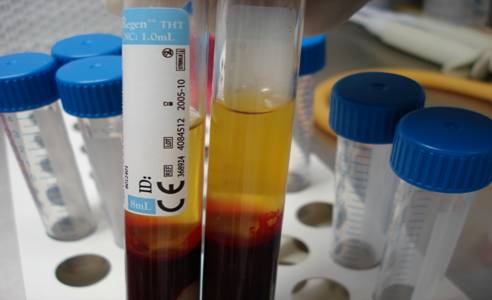 |
| Centrifugal force is used to create platelet-rich plasma. Solid blood elements (white blood cells, red blood cells, and platelets) are separated via centrifugation due to variations in size and density. |
From the Rush Web Site
Platelet-Rich Plasma Clinical Trial at Rush
Can Platelet-Rich Plasma Ease the Pain of Osteoarthritis?
CHICAGO—For years, doctors have used platelet-rich plasma, or PRP, to promote healing after surgery. Now, Rush University Medical Center is studying whether PRP can help relieve knee pain in patients with mild to moderate osteoarthritis. PRP contains growth factors that promote cell proliferation and is prepared from the patient’s own blood tissue. It has received popular attention because of its use in treating sports injuries in professional athletes, but the jury is still out on whether it is effective.
The therapy will not be a cure for osteoarthritis, but it could help put off the day when a patient will need to get a knee implant. At present, the standard of care is either corticosteroid injections, which may last about three months, or synthetic lubricants containing hyaluronic acid, which can last for up to a year.
In the double-blind, randomized, controlled study, 100 patients will receive either hyaluronic acid or PRP. The PRP is prepared from 10 millimeters of the patient’s own blood. The blood is spun in a centrifuge to separate the platelets from the red and white blood cells. The platelets are then injected into the knee joint using ultrasound imaging to guide placement.
Patients will receive three injections over three weeks, and will be monitored for two years receiving a clinical exam to assess pain and knee function. In addition, a teaspoon-size sample will be taken of the synovial fluid around the knee joint to test for molecular changes that may indicate a shift in the balance of anabolic factors that increase the buildup of tissue and catabolic factors that break it down. An imbalance in these factors has been implicated in the deterioration that leads to osteoarthritis.”
I last wrote about PRP on February 22, 2011. Last week, I referred several patients for the Rush study but they didn’t qualify because of age requirements (<55). My patients then told me they were informed that they could receive PRP outside of the study on a fee for service basis. Platelet Rich Plasma alternatives to a joint replacement? Coming from a major academic medical center and a world-renowned orthopedic practice in whose founding and development I played a major role, it is time for me to extend the potential benefit of PRP to my patient as I adopt an increasing proactive role in the world of rejuvantive cellular management for arthritis. To schedule an appointment or to learn more about PRP, call 312 475 1893 and speak to Jennifer Kelly
-
You are currently browsing the archives for the Platelet Rich Plasma category.
REGENEXX CANDIDATE FORM
Dr. Mitchell Sheinkop is now performing Regenexx Procedures in the Chicago area. To learn more about these procedures, visit regenexx.com.
To find out if you are a candidate, please complete the Regenexx Candidate Form, or call us at 312-475-1893 extension 15.


